Answering the Unasked Question

EverDriven's FY2026 UX Maturity Audit
Click the headings to read more.
If we're not user-oriented, we're not doing what's right for the user.
EverDriven was 4-5 months into a major transformation: 10+ product initiatives cascading across the portfolio with significant overlap, new executive leadership, and a clear mandate to make UX a strategic priority. No one asked whether the UX practice was actually equipped to support it. I decided to find out.
The company's platform was badly outdated, and it was building a new platform and backend to catch up with more modern competitors. Internally, that effort was known as the Technology Revolution. Tech was put on a pedestal, but stakeholders didn't fully trust it, largely because of prior communication issues between tech and the organization at large.
Having the right intentions wasn't the same as having the right infrastructure. No one had commissioned an audit, and we had a three-year-old baseline that didn't reflect where we were now. Three things made this the right moment:
- The Technology Revolution. Leadership was new (a CPTO and a VP of Product), and expectations were high with no current measure of where UX stood.
- A solo practice at scale. I'd spent years building foundations, including process documentation, Figma hygiene standards, and a design system completed in the eight months before the audit, largely without formal authority. A formal audit would give those observations structure and credibility.
- An incoming UX Lead. Midway through the interviews, I learned a UX Lead hire was in progress. I wanted that person to walk in with a clear picture instead of starting from zero.
I built and ran a mixed-methods UX maturity audit (based on the NN/g framework) across the whole organization, and used it to answer the question no one had asked: could our existing UX practice support the Technology Revolution? The answer was yes, with specific work to do first.
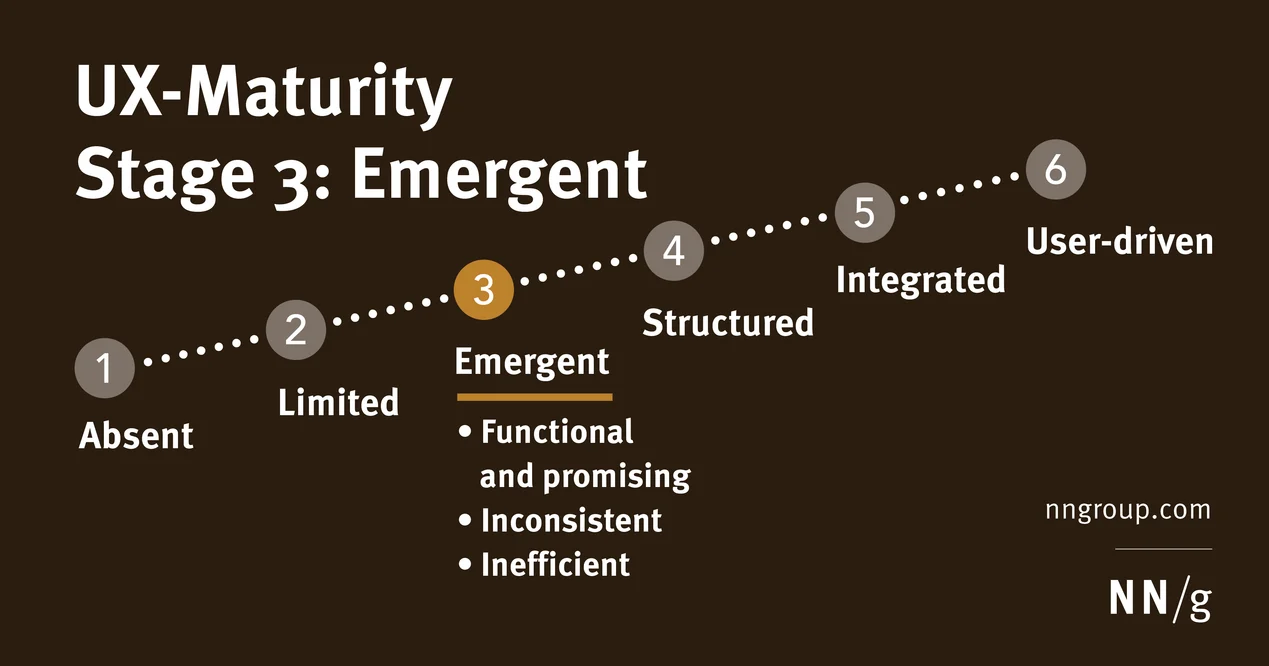
What it changes. Leadership and the incoming UX Lead now had a scored baseline instead of impressions, and a short list of loops the organization had consistently left open: research infrastructure, product request intake, engineering relationships, and connections outside the tech org.
What it found. The organization sat at Level 3, Emergent. It had built strong UX capabilities, but they weren't reaching the whole organization consistently.
Where it stands. The Level 3 baseline is documented for annual re-assessment. The recommendations were partly built, partly adopted, or, in one case, replaced by another system.
Timeline
- August 2025: Planning and artifact collection
- September-October 2025: Interviews and survey
- Late October 2025: Findings presented informally to the UX Lead and the VP of Product
Hypothesis
I went in with a hypothesis: Level 3. New tech leadership had joined earlier that year, UX conversations were happening at levels they hadn't before, and initiatives were being planned with UX at the table. Things felt more actionable, not just supportive in theory.
A survey alone would have given me quantitative data and no guarantee anyone would answer it. Adding interviews gave me depth, which let me flag specific areas for improvement instead of just reporting a score.
The interviews also let me go in depth with different areas of the company. The tech and non-tech sides had been at odds for a while, which the Technology Revolution was meant to fix. I wanted to see where that divide really was.
This was my first time running a maturity audit, so when it came to methodology, I had to make some decisions.
Who to interview was a real debate. Candidates on the tech side, outside of leadership, had to have been at the company for over a year. I initially left the VP of Engineering off the list. He'd created engineering managers to handle day-to-day work, so I wasn't sure he was the right voice for the engineering org at large.
Including the UX Practice in Its Own Audit
I designed the audit to be mixed-methods, cross-functional, and self-included. The UX practice was assessed alongside everyone else.
- 17 stakeholder interviews across four organizational layers: executive, senior leadership, individual contributors, and the UX practice itself
- An organization-wide survey: 30 responses, 19.5% participation, Likert scale plus open-ended questions
- Artifact analysis: the design system, research archives, analytics infrastructure, process documentation, and monthly business review reporting
Claude was used to develop the methodology, structure the interview guide, synthesize findings, and conduct the self-assessment interview. The analysis and judgment calls were mine.
Overall, EverDriven sat at Level 3, Emergent, up from the Level 2 baseline set by an earlier assessment in 2022. (The comparison between the two is directional, not like-for-like.) The same pattern repeated across all four dimensions: the org had built strong UX capabilities, but they weren't reaching the whole organization consistently.
Level 3 matched my hypothesis, so it didn't surprise me. What did was how much leadership support there was, and how far it ran ahead of the process and investment behind it.
Support Without Reach
The core pattern: leadership almost universally supported UX, but the support wasn't trickling down. The further a person sat from leadership and the UX team, the less likely they were to know what UX did. And the support wasn't making it into decisions.
Field Operations, which works directly with drivers, service providers, and districts, was a stark example:
"I don't really know what UX work stands for. How does it affect my role as an FO?" — Survey respondent, Field Operations
The Research Infrastructure Gap
The biggest gap wasn't capability. It was the infrastructure behind the research:
- No research repository, and silos between teams: tech, ops, and sales each gathered their own insights with sporadic sharing
- Little-to-no research initiatives, and no established usability testing process
- Inconsistent metrics tracking: Google Analytics and Microsoft Clarity were installed but not optimized
The visibility gap and the research gap fed the same problem: a reactive cycle that ran at every level of the organization. Without a reliable flow of user information, problems (both software- and competitor-related) were learned about late, and by then someone had usually already landed on a solution. By the time a request reached Product, the ask was to implement, not investigate.
The product request board showed it. It was bloated with a mix of user issues, feature requests, and wishlist ideas, often without enough context to act on. Requests sat unanswered, and at the time of the audit, the board had over 500 tickets.

"From our team, our experience has been that we put in a product request and it just goes to die on the product request board." — Customer Success Manager
Trust in the Product org was low as a result, and the feedback loop was broken. With the problem framed and a solution assumed, there was rarely space to validate, only to execute. But execution without user input or baselines isn't delivery. It's just activity.
Closing the Loops
Leadership hadn't asked whether our existing UX practice could support the Technology Revolution. I answered it anyway. The answer was yes, with four pieces of work to do first:
- Improved research framework: a centralized research repository, Competitive Benchmarker and Research Synthesizer agents to make insights accessible org-wide, and fixing the analytics gaps in Google Analytics
- Redesigned product request intake: structured questions that surface the problem, the user, and the business impact before a request enters the queue, and a better way to group like requests
- Stronger engineering relationships: earlier UX involvement in refinements, better availability for questions, and faster design review turnaround
- Deeper non-tech connections: UX modules in the company LMS, partnering with Marketing and Customer Success on surveys, and proactively reaching out to stakeholders on research
These were the right steps, but advancing to Level 4 would be an ongoing process. As the org grew and the Technology Revolution matured, new gaps would surface. Finding them would mean implementing the audit as a regular event.
I didn't get pushback on the findings. My UX Lead encouraged me to make the research framework a year-long goal. The VP of Product generally agreed that some of our systems were broken and needed fixing, including the product request intake.
Not everything landed the way I recommended. I initially took the intake redesign on as part of the framework. The VPs of Product and Engineering later built their own system, separate from my work. Once implemented, it would filter every request through the C-suite, but it wouldn't give the requestor visibility into request status or the actual pain point raised.
The other recommendations moved more slowly. Engineering managers wanted to work with us more, so I made an effort to be more available. I started building a relationship with the new CX Director, which stalled for the first six months due to other projects.
What happened as a result:
- The UX Lead joined in October 2025, and onboarding was informed by the audit's gaps. That hire was already in progress while the interviews were underway.
- Findings were presented informally to the UX Lead and the VP of Product. The C-suite presentation was planned for November 2025 as two slides at the end of a monthly tech meeting. The meeting ran out of time, and the slides weren't put back on the agenda.
- Partially prompted by the audit, the UX Lead completed a design ops definition and definition-of-done criteria, and made sure the team agreed to the standards they set.
- A UX Research Framework was initiated in response to the research gap findings. It includes the Competitive Benchmarker and Research Synthesizer agents, HEART metrics work, and CSAT infrastructure. The agents were built and in beta use, and HEART workshops had run for three of our live products, but the work wasn't completed before my role was eliminated in a reduction in force. The research repository went live, with a Slack-to-Confluence flow for additions, but adoption was low.
- Our Customer Experience team began releasing service-focused surveys, and in October 2026 began working cross-functionally with the design team to develop future survey instruments with both teams' needs in mind.
- I partnered with training specialists to develop UX modules for the company's new LMS. It didn't go live until July 2026, our busiest time of year, and there wasn't time left to write scripts and record.
- Audit scores were documented for annual re-assessment, with a goal of Level 4 within 12-18 months.
Looking Forward
- I started the next audit, but I won't complete it because my role was eliminated in a reduction in force. I also worked on building AI skills to support interviewing and improved the survey release method with help from our Learning and Development team.
- I set the Level 4 target, based on the 2025 baseline and the work the design team intended to do within 12-18 months. However, I hypothesized that we did not meet that goal when I started the 2026 audit.
Reflection
Sometimes, the most useful thing you can do is be your own advocate.
No one commissioned this audit, and not many people learned from it. I built the methodology, ran the research, and handed leadership something they didn't know they needed, but it never got heard at the level that could act on it.
I'd been vocal about these gaps for years. So had other members of my team. The audit gave those observations data and structure — harder to dismiss, easier to act on.

What I’d Do Differently Next Time
- Break scores out by team rather than aggregate. A single 3.0 almost certainly inflates maturity in some areas and undersells it in others.
- Take the findings to a larger forum, like the company lunch and learns or a separate meeting with only one agenda item.